

A clear demonstration can make window tinting look straightforward. Then you pick up the film and discover the difference between understanding a sequence and controlling it yourself. That gap is not evidence that online learning has failed. It is the part of learning that requires you to do something with the instruction.
The goal is not to finish a video library as quickly as possible. It is to build a process you can repeat, inspect and improve. This roadmap gives each viewing session a practical purpose and helps you decide when to repeat a skill instead of immediately moving to something harder.
Stage 1: watch for decisions as well as movements
Choose a demonstration that matches your current exercise. On the first pass, understand the whole sequence. On the next, watch where the instructor positions the material, what happens before a tool touches it and how a developing problem is recognised. Write down the reason for an action, not only the name of the action.
Pause at a sensible point and ask yourself what should happen next. Then compare with the lesson. The Institute of Education Sciences guide supports active retrieval and alternating worked examples with practice. Applying those general principles to your tinting study is a learning strategy, not a guarantee of a particular completion time.
Stage 2: prepare a controlled practical session
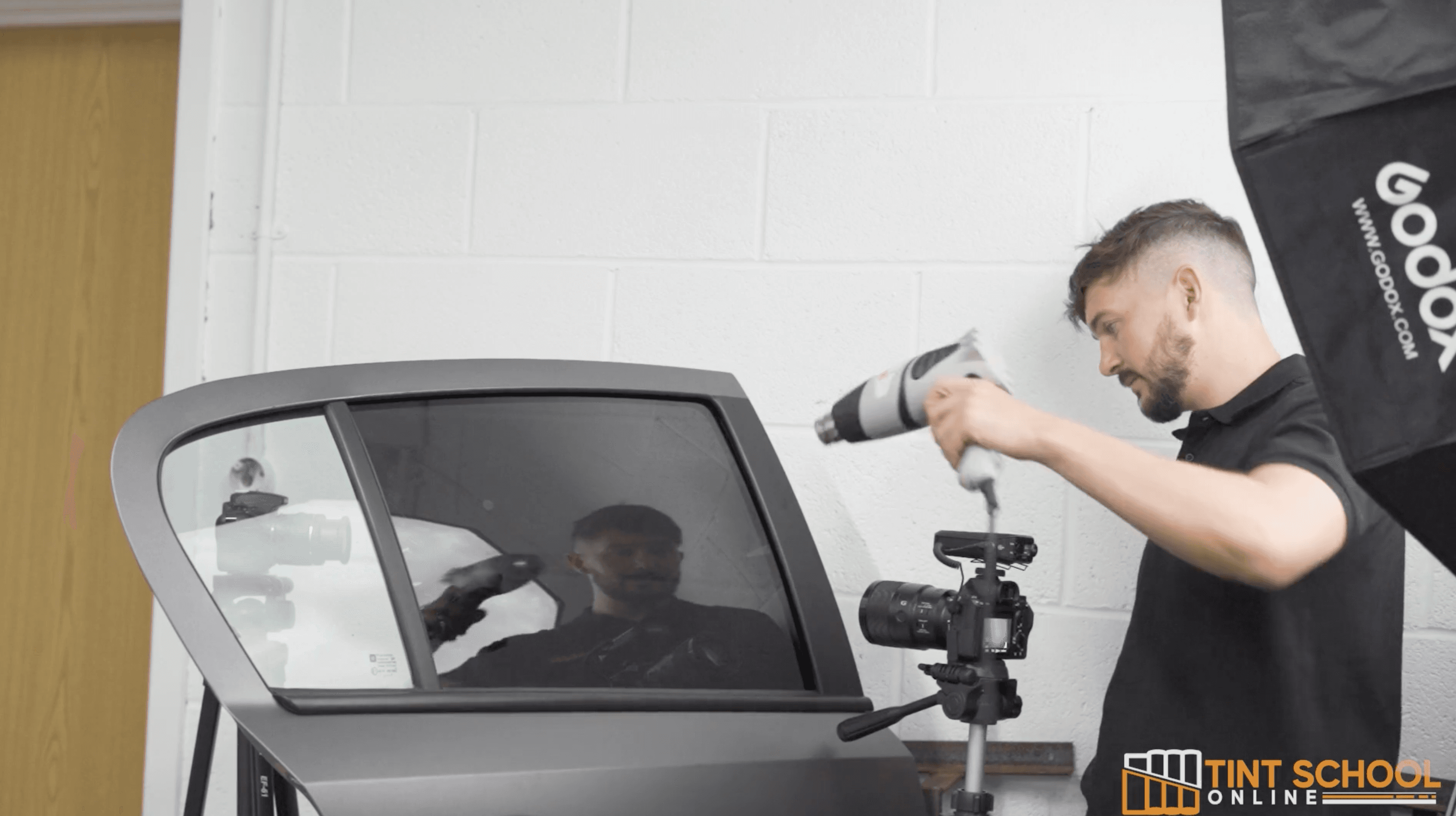
Check your workspace, permission to use the practice vehicle or glass, tools, material and the relevant instructions. Decide what this session is meant to improve. If you need to learn one handling movement, do not turn it into a race to complete an entire unfamiliar vehicle. Build in time to stop, review and clean up.
Before starting, explain the sequence in your own words. If you cannot explain the next stage or do not know how to use a tool safely, return to the relevant instruction. Rehearsing the order does not replace practical work; it prevents avoidable confusion from consuming the practical session.
Stage 3: practise and record what actually happened
Work through the exercise at a controlled pace. Record the point where the result diverged from what you expected. Did the material become difficult to control? Did a mark appear after a particular step? Did you lose time because your setup forced you to keep reaching for something? Those observations are more useful than a broad verdict that you are 'bad at this'.
- Lesson and exercise: the exact skill you were practising.
- Result: a clear photo and a description of what you can actually see.
- Process: material, relevant conditions and the stage where the issue appeared.
- Next test: one change you will make, based on the lesson or qualified feedback.
Stage 4: ask a question someone can answer
'Why does my tint look wrong?' leaves too much missing. A more useful question is: 'I followed this lesson, the issue appeared at this stage, and here is a clear photograph. I have repeated the preparation step; what should I check next?' Give enough context without sharing a customer's private information.
Use the course material and available support route to narrow the problem. TSO's programme includes five core courses, practical demonstrations, business guidance and a private student community. You still need to do the practice, and no question guarantees an instant diagnosis. Good context makes useful feedback more likely.
Stage 5: repeat before adding difficulty
One good attempt shows possibility. Repeated good attempts show a more dependable process. Return to the same skill on another day and see whether you can produce it without constant rescue from the video. Then add an appropriate variation in glass or task, rather than making several unfamiliar changes at once.
Do not use speed as your first proof of competence. An early improvement might be less wasted material, clearer problem recognition or fewer interruptions. As the sequence becomes dependable, track the time for the whole exercise. You want efficiency that comes from control, not from skipping inspection or preparation.
Turn confidence into a service you can stand behind
When you are considering paid work, use the readiness checklist to include scope, vehicle care, inspection and handover. If time is limited, build this loop into the alongside-work schedule. Progress does not need to follow someone else's deadline.
The best moment is not when a video starts making sense. It is when you can explain your process, carry it out and recognise what needs attention. That is confidence with something underneath it—and it is built one useful practice session at a time.
